skip to main |
skip to sidebar
 One of the most impressive sites in Rome is the Palatine. According to Roman legend, this is the place where Romulus and Remus (the founders of Rome) were raised by a wolf in a cave. According to our guidebook, "traces of Iron Age huts dating from the 9th century BC, have been found on the Palatine Hill, providing archaeological support for the area's legendary links with the founding of Rome." There are many different ruins of palaces and temples at this location. There are also ruins of the Stadium and the Farnese Gardens. Our guidebook says that the Farnese Gardens are the first botanical gardens in Europe. This is a beautiful place with a lot of great things to see. There is an entrance fee of 11 Euros and although this may seem a little pricey, it also includes admission into the Colosseum and the Forum. You also are allowed two days to visit these three sites. I suggest trying to do all three in one day, or take your time and break it up into two different trips. I've included a picture of part of the Palatine that you are able to see from the Forum. I snapped this shot the second weekend we were in Rome and a few classmates and I visited the Colosseum and the Forum (regrettably, not the Palatine!)
 Today, the class went to Ostia Antica on a field trip. According to our guidebook, this was the center for commercial trade for Rome and also a military base. It was built around the 1st century BC. Today, the entire city is in ruins, but it is easy to get a general idea of what it used to look like by piecing together the different sections of the city. One of the most interesting and amazing things that I saw while at Ostia Antica was the theater. According to ostiaantica.org, the theater is attributed to the ruler Agrippa. It was built to be able to accommodate 3,000-4,000 people. Presently, you are able to go and see performances by dancers or plays. While I was at the theater, I was amazed. It was very
 open and beautiful and you had an amazing view of the stage. There were actually dancers rehearsing while we were there. It kind of gave you a modern-day feel for what used to happen thousands of years ago. There were certain qualities of the theater that reminded me of the Colosseum. The seating was reminiscent of what the Colosseum's looked like (except the Colosseum's was limestone.) Also, there were giant archways leading into the theater. This is reminiscent of the Colosseum's numbered entry portals. It's intriguing to think that these were the "stadiums" and "arenas" of ancient Rome.
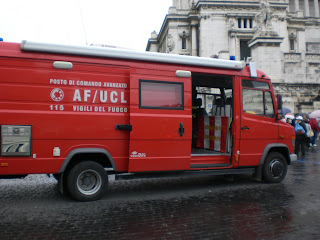 Today is the anniversary of the day that Italy decided to abolish the monarchy and become a republic. Nearly everything in the city was closed today because of the holiday (we still had class though.) There was so much activity going on around Rome! There was a parade on Via del Imperiali which runs from the Colosseum up past the Capital. I walked around on my lunch break and actually got to see tons of people and police officers and firefighters dressed in full uniform. Unfortunately, I miss the parade! I still got a cool picture of an Italian fire truck. OK.. I got a picture of what I THINK is an Italian firetruck because it's red. It might not be. I need to do more research before I can say what it is for sure!
The Palazzo Doria Pamphili is an art gallery that has pieces that date back to the 15th century. Right next to the Palazzo Doria Pamphili is the Palazzo del Collegio Romano which is where my classroom is located.
Coming out of the Termini, make a left onto Via Cavour. Follow Bia Cavour until you reach Via dei Fori Imperiali. At this intersection, the Forum will be right in front of you. Also, if you look down the street to the left, you will be able to see the Colosseum rising up from the distant horizon. Make a right onto Via dei Fori Imperiali. The Capitol will be on your left. Continue straight until you reach Via del Corso. Go straight onto the Corso (you aren't on it for long.) Make a left onto Via Lata. This will bring you into the Piazza del Collegio Romano. The Palazzo Doria Pamphili will be on your left once you come into the opening where cars are parked.
The entire Palazzo Doria Pamphili is made out of stone and has been described as "a great island of stone in the heart of Rome." The outside may appear dark and dreary. However, you are able to see a beautiful courtyard through one of the arching entryways into the Palazzo. There is a large green banner hanging over the entrance to the museum.
 Today, a few classmates and I decided to go on a field trip of our own. We bought passes for 11 Euros that allowed us entry into the Colosseum, the Forum and the Palatine (we didn't get to the Palatine.) However, we began our field trip by going into the Colosseum. My guidebook states that the Colosseum was built as an ampitheater that was used to host gladiator battles and animal fights. It could hold over 50,000 people! However,
  most of the Colosseum has slowly decayed because the interior (including the seats, awning and floor) were made out of materials like limestone or wood that didn't stand the test of time. However, in the Colosseum, a reconstruction of what the floor would look like has been built. It is interesting to see how all of the chambers underneath the floor were like a intricate maze that could hold anything from animals, trees or even people. They were able to be raised and lowered from the floor
 by a system of pulleys. We also decided to go to the Forum. My guidebook says that this was the center of political, judicial and commercial life in ancient Rome. We saw many amazing things such as the Temple of Julius Caesar. The guidebook says that this was erected in memory of Caesar on the spot where his body was cremated after his assassination. We also were able to see the Temple of the Vestal Virgins where priestesses of the Temple of Vesta lived. It was a very peaceful place with some sculptures still intact and a pond with lily pads and frogs in it. The thing that
  I was most excited about seeing was the Rostra which is where speeches were given to the Forum. It was amazing to see the remnants of a structure where so many public speeches were given. As a Communication Arts & Sciences major, this is a very important place for me. Public speaking was basically born here. The art of persuasion had to have been used in all of these speeches so that the people were able to convince others of making changes in ancient Rome. The history of this place is amazing to me and I'm glad that I was able to experience it.


